Europe Unio (EUR) in English
 Germany (EUR) in Deutsch
 Czech Republic (CZK) in Czech
 France (EUR) in French
 Spain (EUR) in Spanish
 Österreich (EUR) in Deutsch
 Polska (PLN) – Polski


How to insulate a front door and stop draughts
A poorly sealed front door – to a house or a flat – lets a lot of heat escape in winter: cold air creeps in through the gaps, the door itself gets cold and the hallway never feels comfortable. A new door is expensive and usually not an option if you rent. With a few simple steps, though, you can insulate your front door much better – without replacing it. The steps below build on one another.
Where a front door loses heat
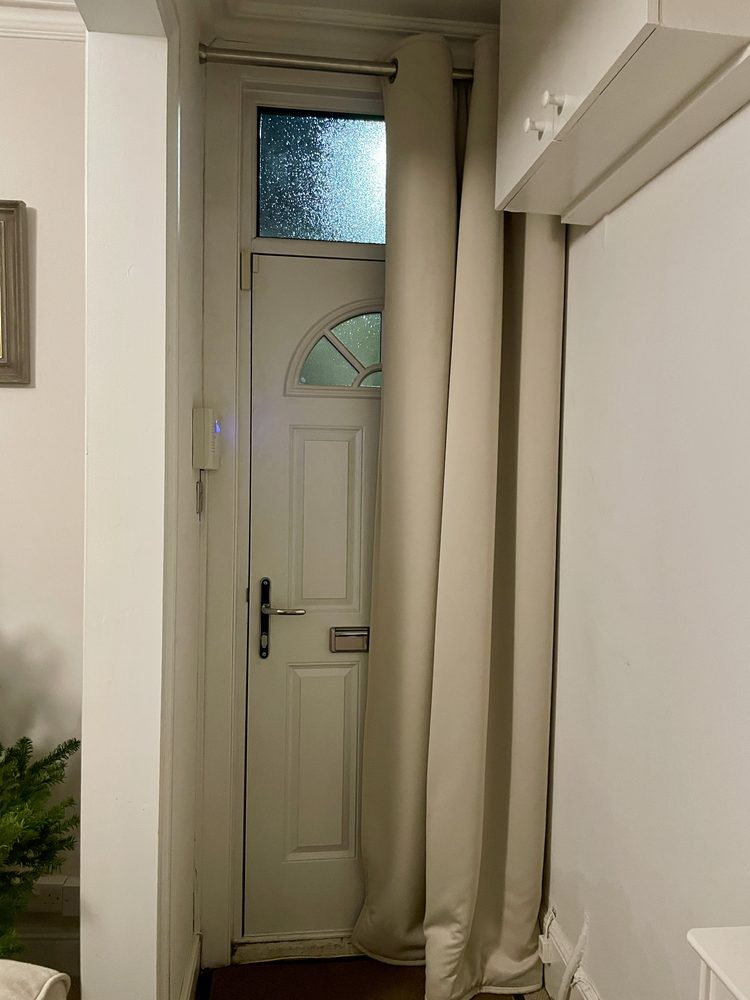 A front door loses heat in three ways. Mostly through the gaps: between the door and the frame, under the door and where the frame meets the wall. Then through the door itself – older doors are often thin or have large glass panels. And finally through the letterbox and the keyhole, where cold air whistles in when the wind blows.
Step 1: Find the draughts
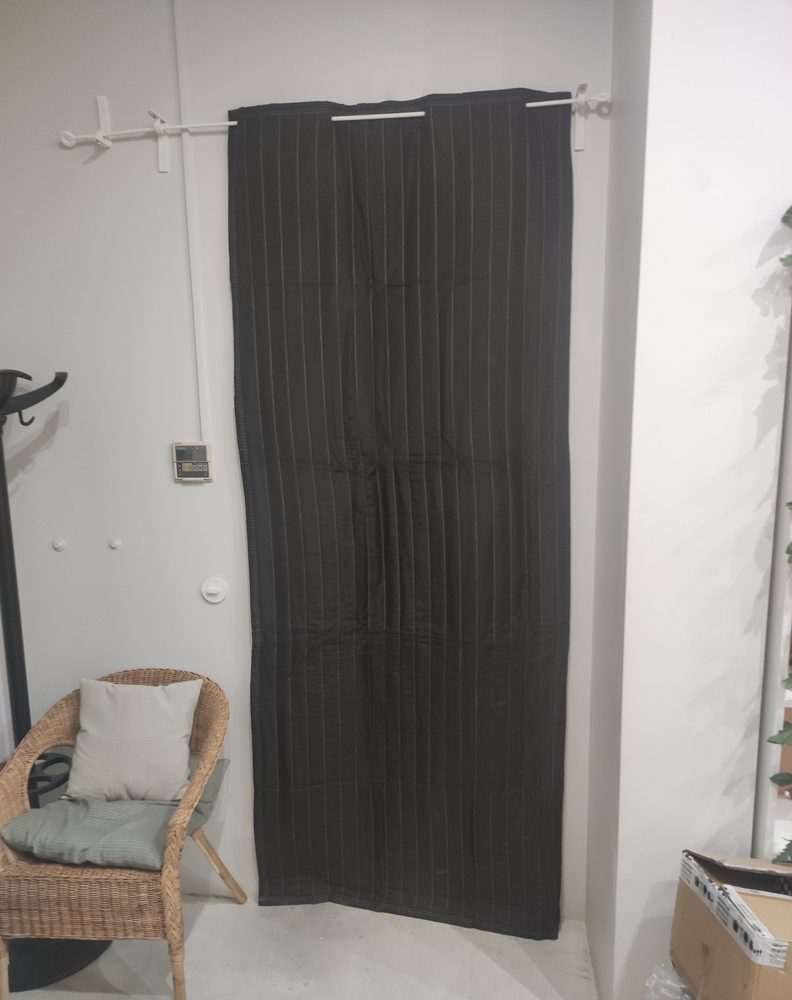 On a windy day, run your hand slowly along the door frame: wherever you feel moving air, the door needs sealing. A candle or an incense stick shows it even more clearly – if the flame flickers or the smoke drifts sideways, there is a leak. A simple test: close the door on a sheet of paper. If you can pull it out without any resistance, the door does not close tightly at that point.
Step 2: Renew the seals
Sealing the gaps is the cheapest step and the one with the biggest effect:
- Replace old, flattened seals in the door frame with new rubber seals, so that the door closes tightly all the way round.
- Close the gap under the door with a door bottom seal – ideally an automatic drop-down seal that lowers itself when the door shuts.
- Adjust the hinges and the strike plate if the door does not shut firmly.
- Seal any cracks between the frame and the wall, and fit a brush draught excluder to the letterbox.
Step 3: Hang a thermal curtain in front of the door
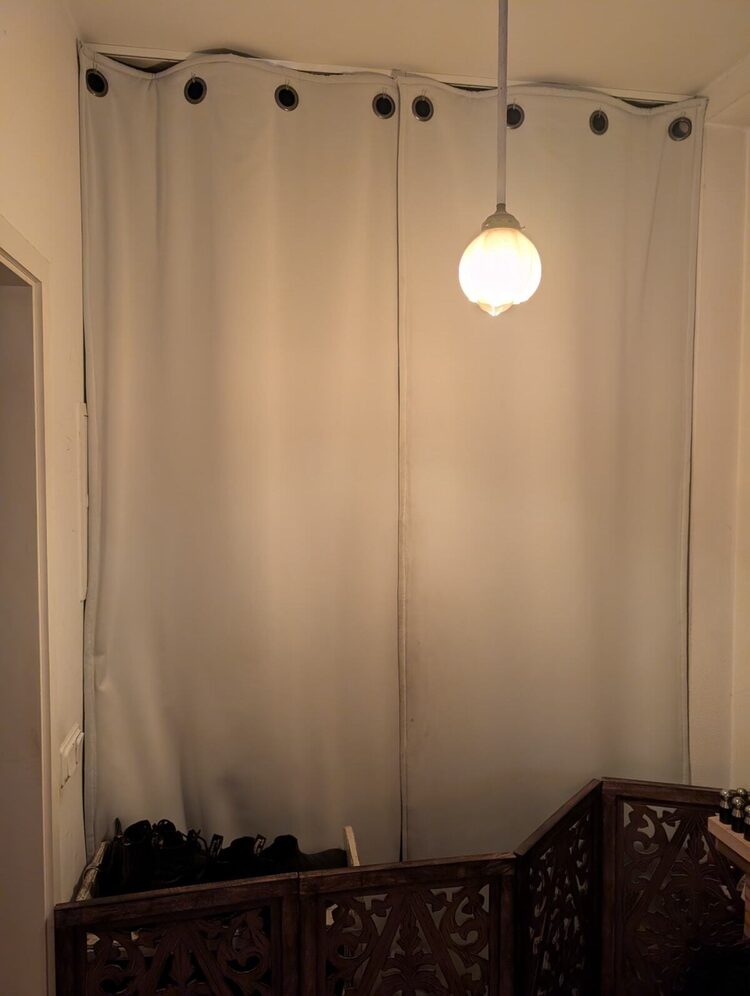 A heavy curtain creates a layer of still air in front of the door and keeps the cold air that still gets past the seals out of the room. To work, it has to be heavy, overlap the door at the sides and the top, and reach almost to the floor – the door bottom seal closes the remaining gap at floor level. Ideally it hangs from a ceiling track or a sturdy pole, so that there is no gap at the top; to go through, you simply slide it aside.
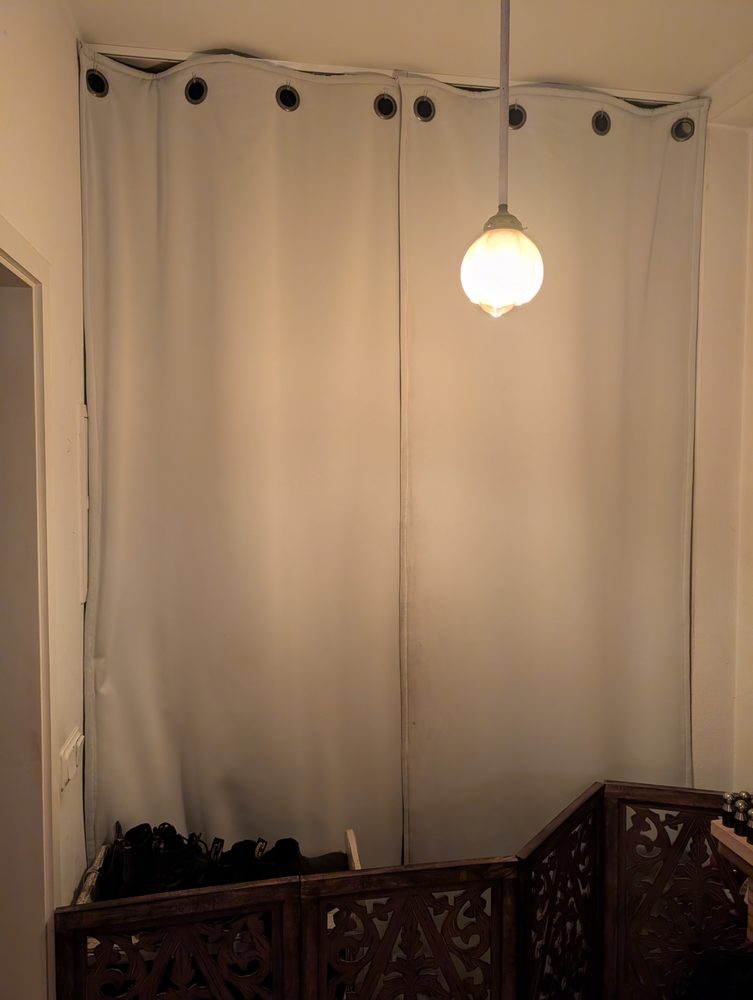 You will find suitable options in our thermal door curtains category: the ready-made double-layer door blanket 100 × 235 cm or made-to-measure curtains for wider and double doors. According to our product data sheets, the curtains provide thermal insulation of 30 to 85%, depending on the model. Celine from the UK hung our heavy deNoise PRO 1550 curtain at her window and writes in her review: “It's also good at blocking drafts and keeping the space warm.”
Step 4: What else helps
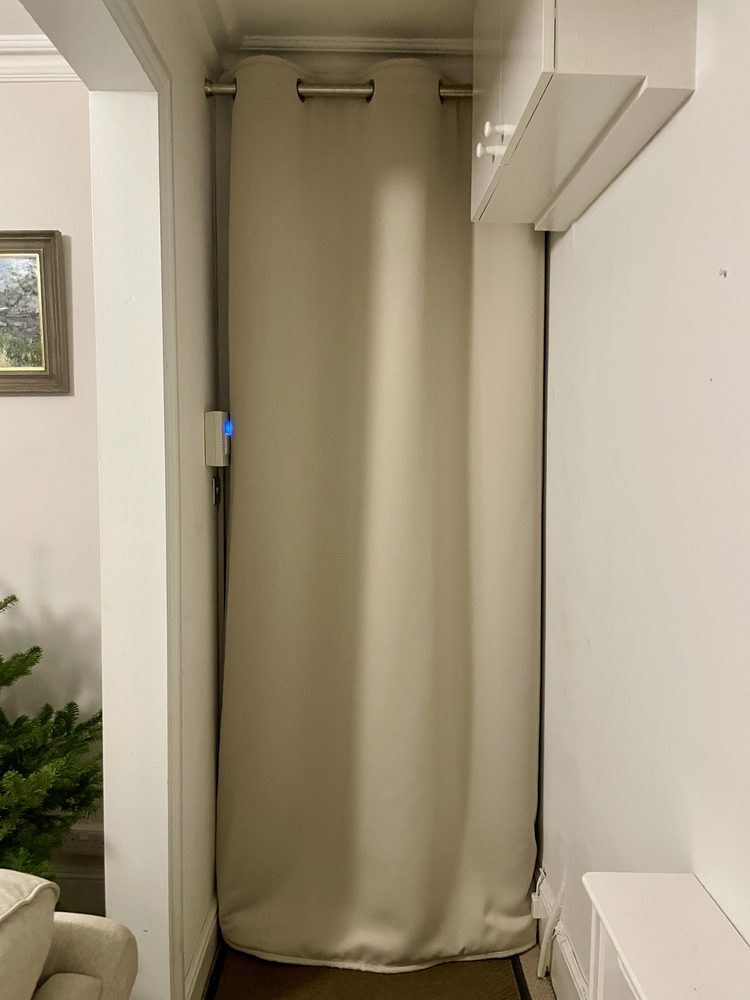 As well as the steps above, a few small measures help too:
- A draught excluder at the foot of the door, if there is no door bottom seal yet.
- A keyhole cover on the inside.
- A curtain on the door between the hallway and the living area as well, so that cold air from the hallway does not reach the living rooms.
When is a new front door worth it?
If the door is warped, the wood is cracked or it has only single glazing, seals and a curtain will only ease the problem. In the long run, a new, well-insulated door is then the better solution. Until then – and in any rented home – the steps in this guide are the quickest and cheapest way to a warmer hallway.
Frequently asked questions
Answers to the questions customers ask us most often about cold, draughty front doors.
Does a thermal curtain on a front door really help?
Yes, if it is heavy and covers the whole door. A thin decorative curtain hardly keeps any heat in; a curtain with a dense, heavy lining such as our deNoise PRO 2850 provides thermal insulation of 65 to 85% according to its data sheet.
Does the curtain also help against noise from the stairwell?
Yes – depending on the model, our curtains reduce noise by 10 to 37 dB. If noise is your main concern, take a look at our door soundproofing range.
Can the curtain be made to fit my door?
Yes. Every curtain is sewn to measure in our workshop – including for wider and double doors.
Related options: Thermal curtains.