Europe Unio (EUR) in English
 Germany (EUR) in Deutsch
 Czech Republic (CZK) in Czech
 France (EUR) in French
 Spain (EUR) in Spanish
 Österreich (EUR) in Deutsch
 Polska (PLN) – Polski


Certificate – weighted sound absorption coefficient αw = 1.00 – CBT-WD ceiling acoustic blanket (double layer)
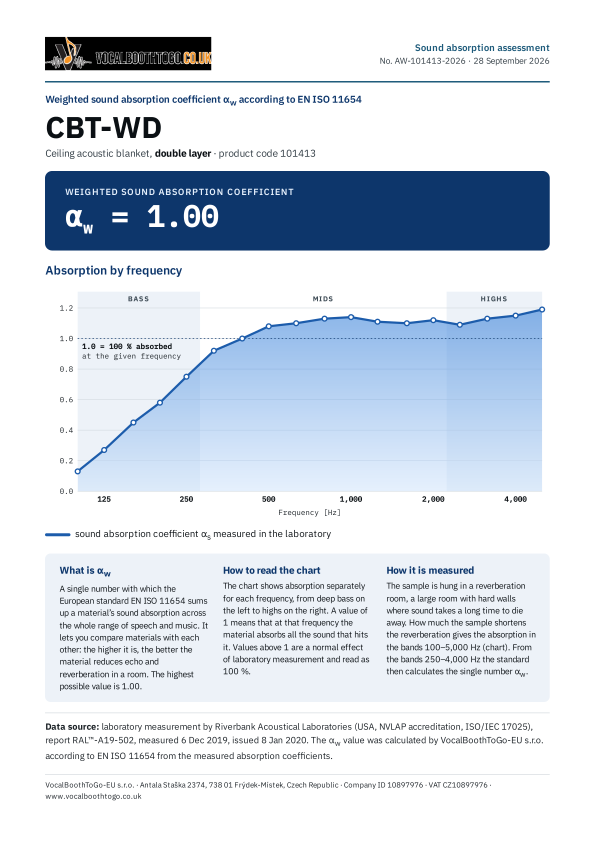
Laboratory measurement of the sound absorption of the material of the CBT-WD ceiling acoustic blanket (double layer) in the reverberation room of the independent Riverbank Acoustical Laboratories (USA, NVLAP accreditation, ISO/IEC 17025). The blanket is made of the same material as our large acoustic blankets. The measured values give a weighted sound absorption coefficient of αw = 1.00 according to the European standard EN ISO 11654.
How much sound a double layer absorbs
The chart shows what percentage of incident sound the double-layer ceiling blanket absorbs at each frequency, from deep bass on the left to highs on the right. Thanks to the second layer it absorbs a lot even in the bass (27 % at 125 Hz, 75 % at 250 Hz) and practically 100 % of the sound from 400 Hz upwards. From these values a single number is calculated according to EN ISO 11654, αw = 1.00, the highest possible value, which lets you easily compare the blanket with other acoustic materials. The detailed PDF version contains the step-by-step αw calculation and the original laboratory report.
Downloads: αw assessment (PDF, 1 page) · Detailed assessment with calculation and the original Riverbank report (PDF)
Single vs. double layer
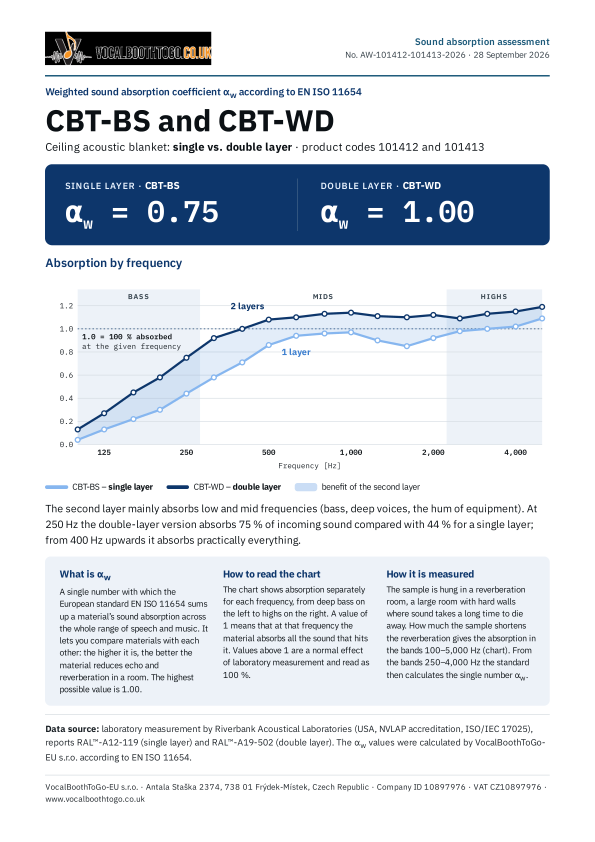
Both measurements in one chart: the light line is the single layer (CBT-BS), the dark line the double layer (CBT-WD). The shaded area shows how much more sound the second layer absorbs. The difference is largest in the bass, e.g. 27 % instead of 13 % at 125 Hz and 75 % instead of 44 % at 250 Hz. From 500 Hz upwards both absorb over 85 % of the sound.
Single vs. double layer comparison (PDF)
Product: CBT-WD ceiling acoustic blanket