Europe Unio (EUR) in English
 Germany (EUR) in Deutsch
 Czech Republic (CZK) in Czech
 France (EUR) in French
 Spain (EUR) in Spanish
 Österreich (EUR) in Deutsch
 Polska (PLN) – Polski


Certificate – weighted sound absorption coefficient αw = 0.75 – CSB-BS ceiling baffle (single layer)
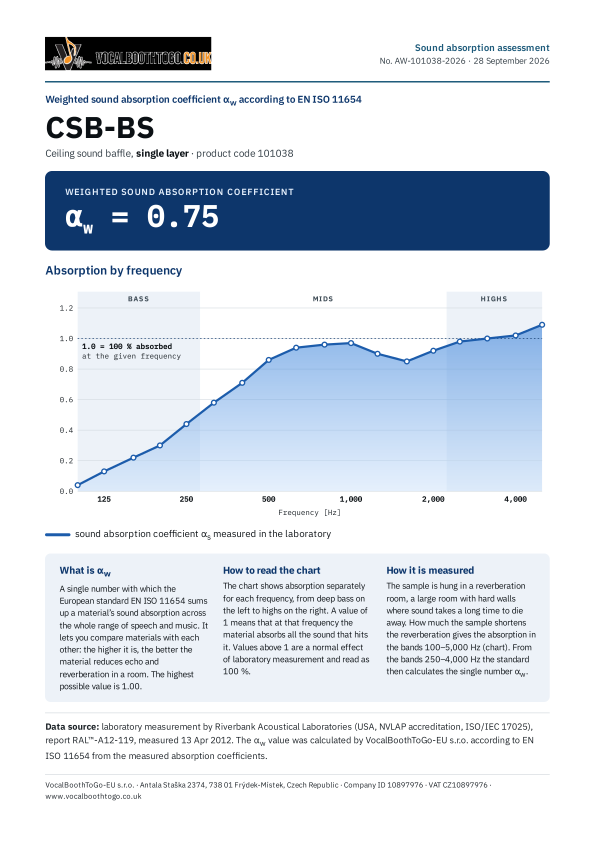
Laboratory measurement of the sound absorption of the material of the CSB-BS ceiling baffle (single layer) in the reverberation room of the independent Riverbank Acoustical Laboratories (USA, NVLAP accreditation, ISO/IEC 17025). The baffle is made of the same material as our acoustic blankets. The measured values give a weighted sound absorption coefficient of αw = 0.75 according to the European standard EN ISO 11654.
How much sound a single layer absorbs
The chart shows what percentage of incident sound the single-layer baffle absorbs at each frequency, from deep bass on the left to highs on the right. In the bass it is less (13 % at 125 Hz, 44 % at 250 Hz); from 500 Hz upwards it is over 85 %, i.e. across the whole range of the human voice. From these values a single number is calculated according to EN ISO 11654, αw = 0.75, which lets you easily compare the baffle with other acoustic materials. The detailed PDF version contains the step-by-step αw calculation and the original laboratory report.
Downloads: αw assessment (PDF, 1 page) · Detailed assessment with calculation and the original Riverbank report (PDF)
Single vs. double layer
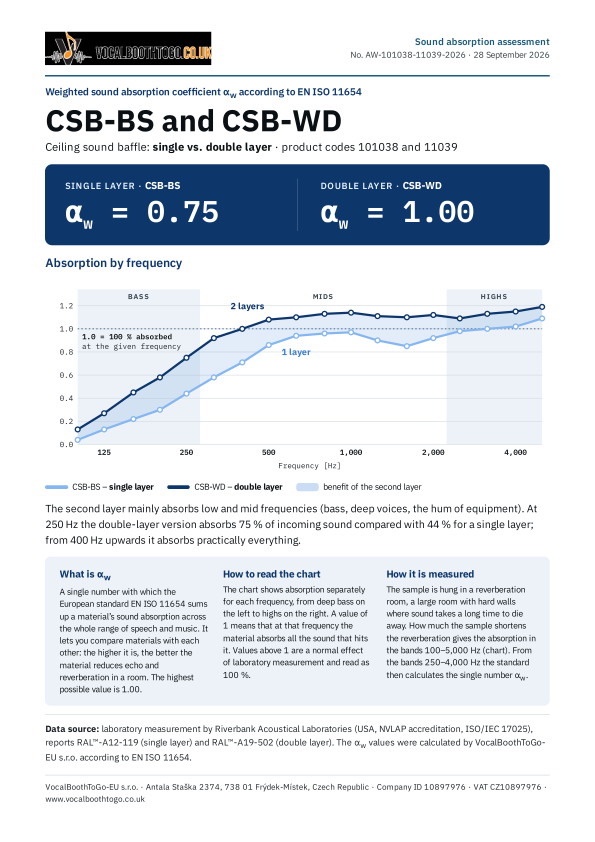
Both measurements in one chart: the light line is the single layer (CSB-BS), the dark line the double layer (CSB-WD). The shaded area shows how much more sound the second layer absorbs. The difference is largest in the bass, e.g. 27 % instead of 13 % at 125 Hz and 75 % instead of 44 % at 250 Hz. From 500 Hz upwards both absorb over 85 % of the sound.
Single vs. double layer comparison (PDF)
Product: CSB-BS ceiling baffle