Europe Unio (EUR) in English
 Germany (EUR) in Deutsch
 Czech Republic (CZK) in Czech
 France (EUR) in French
 Spain (EUR) in Spanish
 Österreich (EUR) in Deutsch
 Polska (PLN) – Polski


Certificate – weighted sound absorption coefficient αw = 0.75 – deNoise PRO 1550 (single layer)
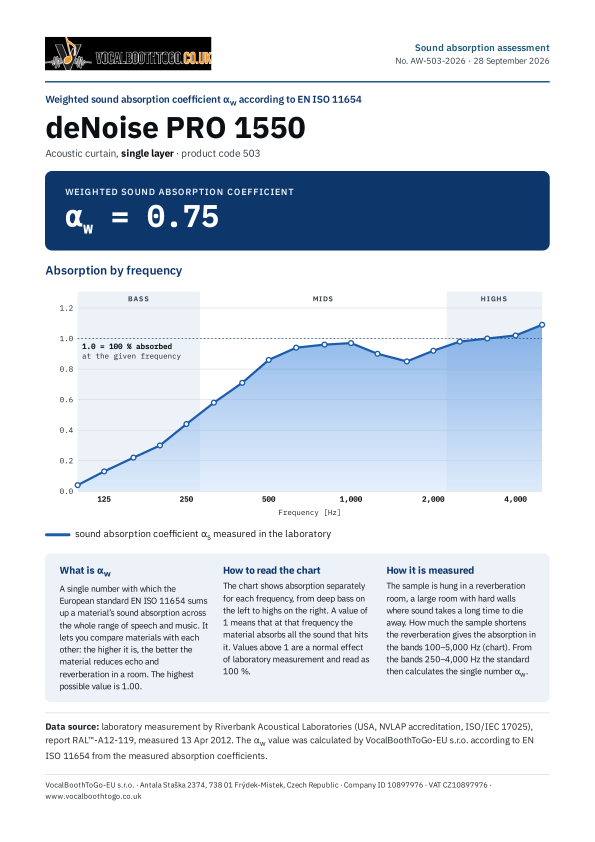
Laboratory measurement of the sound absorption of the deNoise PRO 1550 acoustic curtain (single layer) in the reverberation room of the independent Riverbank Acoustical Laboratories (USA, NVLAP accreditation, ISO/IEC 17025). The measured values give a weighted sound absorption coefficient of αw = 0.75 according to the European standard EN ISO 11654.
How much sound a single layer absorbs
The chart shows what percentage of incident sound a single layer of the curtain absorbs at each frequency, from deep bass on the left to highs on the right. In the bass it is less (13 % at 125 Hz, 44 % at 250 Hz); from 500 Hz upwards it is over 85 %, i.e. across the whole range of the human voice. From these values a single number is calculated according to EN ISO 11654, αw = 0.75, which lets you easily compare the curtain with other acoustic materials. The detailed PDF version contains the step-by-step αw calculation and the original laboratory report.
Downloads: αw assessment (PDF, 1 page) · Detailed assessment with calculation and the original Riverbank report (PDF)
Single vs. double layer
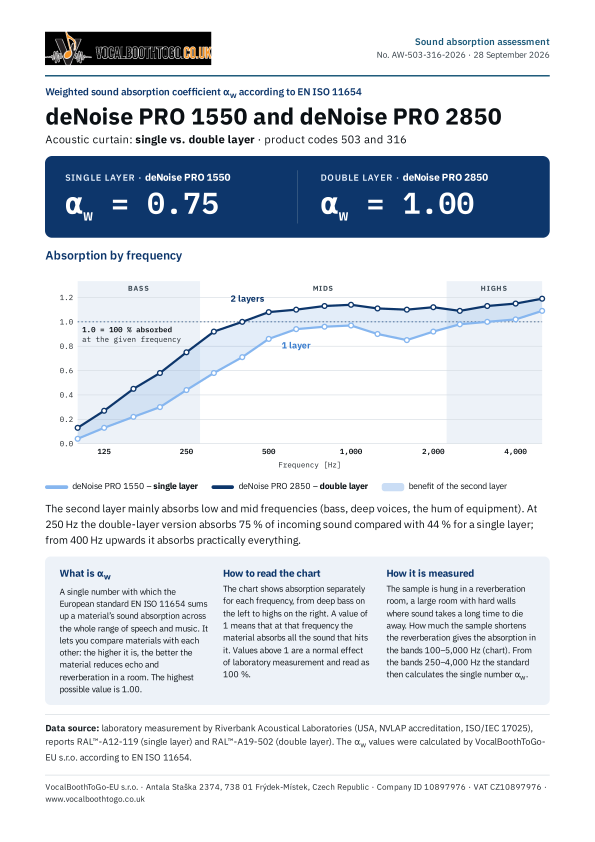
Both measurements in one chart: the light line is the single layer (deNoise PRO 1550), the dark line the double layer (deNoise PRO 2850). The shaded area shows how much more sound the second layer absorbs. The difference is largest in the bass, e.g. 27 % instead of 13 % at 125 Hz and 75 % instead of 44 % at 250 Hz. From 500 Hz upwards both absorb over 85 % of the sound. The double layer also dampens noise coming through a window or door better.
Single vs. double layer comparison (PDF)
Product: deNoise PRO 1550