


 Europe Unio (EUR) in English
 Germany (EUR) in Deutsch
 Czech Republic (CZK) in Czech
 France (EUR) in French
 Spain (EUR) in Spanish
 Österreich (EUR) in Deutsch
 Polska (PLN) – Polski


How to soundproof a door: a step-by-step guide
If you can hear every word from the hallway with the door closed, the door is the weak point of your room. Most interior doors are light, often hollow inside, and there are gaps under them and around the frame. The good news is that you do not have to replace the door: in most cases it is enough to close the gaps and add mass to the door you already have.
Why a door lets so much noise through
Sound is stopped by mass and by airtightness, and a typical door has neither. A standard interior door weighs far less than the wall around it, so it vibrates with the sound and passes it on. The gaps are an even bigger problem: there is often a gap of a centimetre or more under an interior door, and the door does not always press evenly against the frame. Glass panels in the door let through sound and light as well.
Step 1: Close the gaps around the door
Start with the gaps, because noise slips through them even when the door itself is heavy:
- Fit self-adhesive rubber seals into the rebate of the door frame, so the door closes against them all the way round.
- Close the gap under the door with a door sweep or, better still, an automatic drop-down seal that lowers when the door is shut.
- Adjust the hinges or the strike plate if the door does not close firmly.
Make sure fresh air can still get in, for example through a window vent – every room needs ventilation, especially a bedroom.
Step 2: Add mass with a door soundproofing panel
The most effective thing you can do without a carpenter is to make the door heavier. Our door soundproofing panels are made to the exact size of your door, with a hole for the handle, and attach directly to the door leaf:
- NovaSilence MLV – a 3 mm layer of mass loaded vinyl and a 1300 g/m² acoustic layer facing the room. It reduces noise by 22 dB at low, 30 dB at mid and 45 dB at high frequencies. Fabric surface, ideal for interior doors.
- FrontSilence MLV – the same vinyl core and acoustic felt with a wipeable faux leather surface and the same 22/30/45 dB. Designed mainly for the outer side of front doors, but it can be fitted on either side.
- LiteSilence – two layers of our acoustic material (2600 g/m²) without vinyl. It absorbs sound and echo and is the lighter option.

The panels attach with a 10 cm Velcro strip whose self-adhesive counterpart you stick to the door. No drilling is needed for the Velcro, and if you remove the panel later, the adhesive strip stays on the door. NovaSilence can alternatively be mounted with a metal bracket made for rebated or flush doors. On glazed doors the panels also block the light completely.
Step 3: Or hang a blanket in front of the door
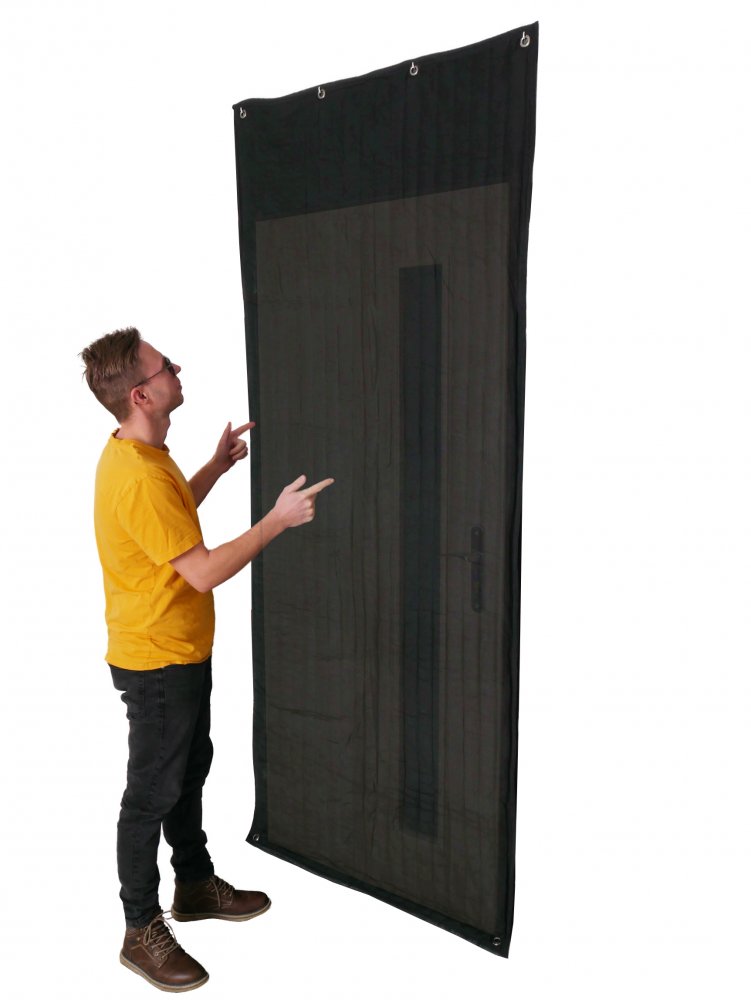
If you cannot or do not want to attach anything to the door – in a rented flat, for example, or on a door you rarely use – hang a heavy blanket or curtain in front of it. Our DNC door blanket is double-layered, measures 100 × 235 cm and hangs above the door frame from 12 mm grommets. To keep out draughts at the front door in winter, see our thermal door curtains.
Which solution suits which door?
The right choice depends on how often the door is used and what you want to keep out:
- Front or entrance door – FrontSilence: its faux leather surface withstands daily use and can be wiped clean.
- Bedroom, study or nursery door – NovaSilence: the most mass for an interior door, with a fabric surface.
- Door with glass panels – NovaSilence or LiteSilence: they cover the glass and block the light completely.
- A door you rarely open, or a rented flat – the DNC door blanket, with nothing attached to the door itself.
A customer's experience: a rented room in Ireland
Nicholas from Ireland soundproofed the door of a room he was going to let. He wanted as much privacy as possible on both sides, so he fitted two NovaSilence panels: a white one on the hallway side and a black one on the side facing the room.
 “Installation using the provided Velcro was really easy and the result exceeded my expectations. We didn't hear any conversations or quarrels from the neighbours. Even loud music would be really hard to notice.
 I'm really happy with the product. I would highly recommend anyone who wants peace of mind at home to try NovaSilence in black or white on their door.”
Frequently asked questions
Answers to the questions customers ask us most often about soundproofing doors.
Can I soundproof a door without replacing it?
Yes. Seal the gaps around and under the door and add a soundproofing panel – that usually makes voices and TV from the rest of the home much less intrusive.
How much noise does a door panel stop?
NovaSilence and FrontSilence: 22 dB at low, 30 dB at mid and 45 dB at high frequencies. How much you hear in practice also depends on the gaps around the door.
Does the panel need drilling?
Not with the Velcro: its self-adhesive counterpart simply sticks to the door. NovaSilence can also be mounted with a metal bracket for rebated or flush doors.
How quickly is a panel made?
Every panel is made to measure in our workshop within 1–2 working days and then shipped.